Three-Power Nuclear Instability and Possibilities for Diplomatic Intermediation
Below is the prepared text upon which Dr. Ford based his shorter oral remarks on December 7, 2025, at the Doha Forum, on a panel on “Mediating in an Era of Nuclear Risks and Superpower Rivalry” organized by the Qatar Mediation Forum. Dr. Ford was joined on the panel by Dmitri Suslov and Wu Chunsi, and the discussion was moderated by Ambassador Karim Haggag, director of the Stockholm Peace Research Institute.
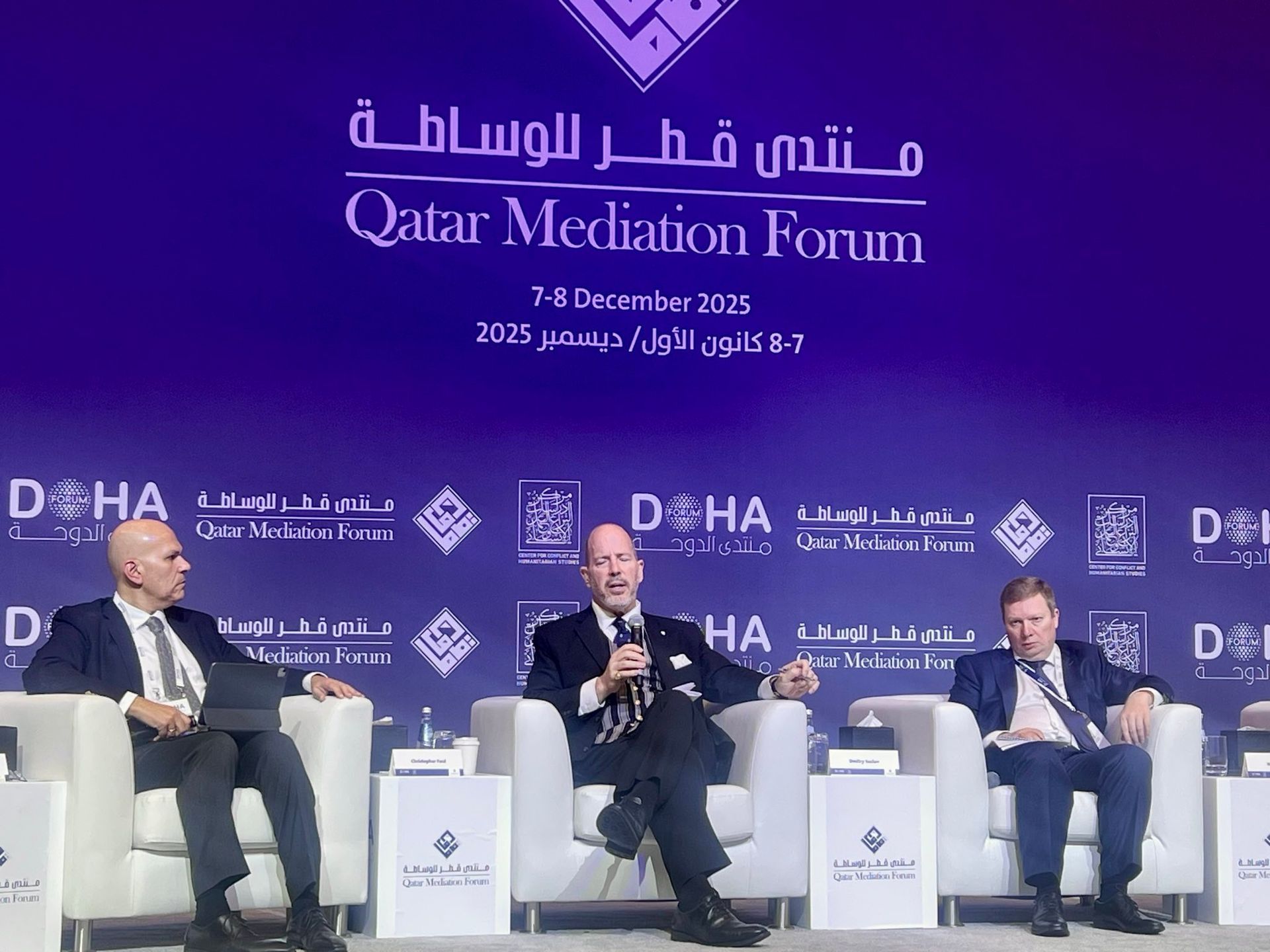
Good day, everyone, and my thanks for inviting me. It’s my first visit to Qatar, and I’m pleased to be here for this important event.
As always, I can offer here only my personal opinions, and I speak neither for Missouri State University’s School of Defense and Strategic Studies, nor for the Center for Strategic and International Studies in Washington – nor, in fact, for anyone else. Nevertheless, it’s a pleasure to be here, and I’m happy to offer some thoughts on nuclear risks between the United States, China, and Russia, and the possibility of intermediation.
Perils of the Current Three-Power Nuclear Problem
From a U.S. perspective, I see the emergence of three-way multipolar great power rivalry as being enormously dangerous. To some extent this is just because of the inherent challenges of the so-called “three-body problem” we are coming to face of deterring two nuclear near-peers at the same time – since, as perhaps in Newton’s celestial mechanics, a three-body game-theoretical solution may be inherently unstable.
In addition, however, U.S. strategists see these developments as particularly problematic not just because of this three-way dynamic but because that dynamic also seems notably lopsided. This lopsidedness is a result not just of the “no-limits” partnership that has been proclaimed between China and Russia, but also because of the military alliance that has emerged between the Russians and the dangerous proliferator regime of the Kim family dynasty in North Korea, and also the now considerable defense cooperation between Russia and the belligerent theocracy in Tehran. These are new, novel, and – from our perspective in the United States – understandably dangerous developments.
So it’s not hard to see how this seems hugely destabilizing, and there should be nothing surprising in Washington’s resulting unease and antagonism. I have to imagine that Beijing, for instance, would look on things with special alarm if Washington and Moscow announced that they were now security partners “without limits,” and if they openly espoused their desire to “contain” China and reduce its power and influence in the world. (Or that Moscow would be appalled if the Americans and Chinese similarly ganged up on the Russians.) Yet that’s what they both say about us, and are working hard to accomplish.
As bad as the “three-body problem” already will be, in other words, there’s thus also an additional element now in play – namely, what is, not to mince words, a destabilizing geopolitically revisionist anti-American (and broader anti-Western) conspiracy by the world’s most powerful dictators. Having two nuclear near-peers and their rogue proliferator regime tag-alongs coordinating against you is clearly a very big deal indeed, and it is likely to elicit reactions from the United States that Beijing and Moscow will in no way like – though they will of course have brought it on themselves.
Making matters worse, Russia and (especially) China continue to be hostile to U.S. efforts to engage them in serious risk-reduction dialogue, let alone arms control negotiations intended to find a way to rein in capabilities and practices that the parties find most destabilizing. Because they have so systemically invested in strategies of risk-manipulation in support of their agendas of reshaping the international order in ways congenial to their territorially aggressive ambitions, Beijing and Moscow both seem to have concluded that such “risk reduction” isn’t actually in their interest.
Indeed, China and Russia seem to be promoting a philosophy of “crisis prevention” which amounts to demanding that they be given free rein to invade and annex their neighbors, in response to which the rest of the world should “prevent conflict” by not doing anything to impede such invasions. This is clearly an absurd and world-historically dangerous proposition – a callous ancient logic of imperialist hegemonism that is utterly antithetical to the preservation of international peace and security – but they advance it quite unashamedly. As a result, the world now faces enormous nuclear risks: a very considerable chance that a war of territorial aggression such as the one in Ukraine, or the one that seems ever more possible over Taiwan, will lead to nuclear weapons use and dangerous pressures for further escalation.
The threat of such wars of conquest and annexation, moreover, is creating new proliferation pressures both in East Asia and in Europe. Where once the primary risk of nuclear weapons proliferation stemmed from disruptive authoritarian regimes such as North Korea and Iran, these renewed threats of Russian and Chinese aggression – coupled with a growing degree of worrisome ambivalence in Washington about America’s traditional alliance relationships and security partnerships – are beginning to raise the risk of so-called “friendly proliferation” by countries who may simply see no other way to preserve their existence in the face of such threats.
So are there great and growing nuclear risks. Oh yes, indeed.
Nuclear Risk and the End of New START
As this account implies, however, I see the primary locus of nuclear risk lying not in the imminent disappearance of the New START agreement – or in the stereotypical “bolt from the blue” about which strategists worried a great deal in the Cold War – but rather in escalation out of a conventional conflict in either the European or East Asian theaters.
I would agree that there's certainly a pretty high likelihood of Washington and Moscow both increasing their nuclear numbers after New START goes away, and there may be additional nuclear risk there. Nevertheless, both we and the Russians have faced each other with vastly larger numbers of nuclear weapons before, and I don’t see higher numbers as being the primary locus of nuclear risk.
I should also note that there’s probably real nuclear risk if the United States doesn’t augment its nuclear posture somewhat. It’s no coincidence that Russian President Putin began proposing a brief extension of New START’s central limits after the U.S. strategic policy community began openly talking about the need to increase American warhead numbers and develop new systems; he wants us to refrain from doing what it’s now clear we need to do in order to preserve deterrence and strategic stability as our “two-peer” problem worsens. His proposal is hence a rather bad idea.
Higher U.S. and Russian numbers might also have the added benefit of delaying the day of reckoning for the full emergence of a “three-body problem” of nuclear peer deterrence. Despite the remarkable speed of Beijing’s huge current nuclear build-up, after all, it would presumably take China longer to reach strategic parity with the United States and Russia if reaching such parity required China to build to a higher level. And such additional delay might give all our respective diplomats longer to try to sort out a more constructive way forward between the three powers. So I don’t oppose somewhat higher numbers of U.S. and Russian strategic systems, and I certainly don’t think that’s the major nuclear risk we face.
Rather, as indicated, I think the biggest nuclear risk right now comes from escalation out of a regional war, and New START says essentially nothing about that. By far the most important drivers of actual nuclear risk are: (1) the Sino-Russian proclivity for wars of territorial aggression; (2) the strained solidity of America’s alliance networks and security partnerships; (3) the increasingly America-unfavorable relative balance of conventional forces in each theater; and (4) Russian and Chinese advantages in sub-strategic nuclear systems which could lead either or both of them to think they enjoy enough escalation dominance to deter us from acting to stop them from attacking their neighbors. The end of New START is nothing compared to this ugly combination of factors.
Can we Reduce Risks?
In the absence of Chinese and Russian willingness to talk seriously about these things, I don’t see much prospect for improvements in transparency and confidence-building measures between the three powers. U.S. officials – including me – have tried for years to engage their trilateral counterparts on such matters, to no avail. Sadly, powers whose strategies of self-aggrandizement rely upon creating and profiting from geopolitical instability simply don’t want to do much to reduce nuclear risks, much less to agree to meaningful arms control restraint.
Perhaps I’m too cynical about such things, but I also don’t agree with the facile assumption often made by professional diplomats and civil society activists that the main problems between these three powers stem from a “lack of mutual understanding.” As I tried to suggest to an audience at Harvard two weeks ago, for instance, it’s quite possible that we actually understand each other all too well – at least in the essentials – and that it is precisely this clarity about the degree to which our interests and objectives really do deeply conflict that helps keep our leaders on edge against each other. Perhaps that’s not misunderstanding; it’s just perceptiveness.
That said, as I also emphasized to that audience at Harvard, I think there would still be value in building better ways to keep talking to each other in times of calm and crisis alike. As I put it then,
“Doing more to routinize and institutionalize diplomatic engagement with each other over national security policy …could hardly be a bad thing – and might help, at the margins, in at least keeping things from being worse between the two rivals than structural circumstances all but compel them to be. …
“That way, at least, we would have a fighting chance of being able to talk reliably to each other on a regular basis. … [B]etter communications links and habits can at least help prevent actual misunderstandings, as well as giving our leaders better tools with which to try to manage the challenges and crises that are sure to arise along our two countries’ intersecting trajectories.”
To be sure, we already have at least some means of crisis communication between us. The Americans and Russians have had a “hotline” for decades – having struck an agreement to this effect in 1963, just after the Cuban Missile Crisis – and there has also been a loose U.S.-Chinese analogue in place since 1998, as well as a military-to-military Defense Telephone Link (DTL) arrangement since 2008. U.S. officials have recently said, moreover, that they are now working with Chinese counterparts to improve military-to-military crisis communication channels further. That’s all for the good.
But these mechanisms remain flawed, not least because the Russians and (especially) Chinese apparently don’t like to use them very much. U.S. officials have complained for years, for example, that Chinese officials often simply don’t answer when Americans try to reach them, while Chinese and Russian leaders also routinely shut down ongoing dialogues every time they want to express grievance over something or pressure Washington into making some kind of diplomatic concession.
Both Beijing and Moscow clearly feel that we Americans care about such diplomatic engagement and communication channels more than they do, and they thus see our communications and dialogue channels less as opportunities to manage problems between our countries than as additional chances to exert leverage against Washington. So I’m not hugely optimistic about improving such dialogue and such communications.
Nevertheless, I still think it’s important to try. For example, I’d like to see regularized and routinized security and strategic stability dialogues, both with Russia and with China, as well as for China to plug itself into the existing multilateral communications network of the U.S.-based Nuclear Risk Reduction Center. Such dialogues and communication channels probably wouldn’t be very useful most of the time, but it would be very valuable to have them available – and for using them to become a comfortable and routine way of interacting – before things get spicy.
A Role for Intermediaries?
As for the role of potential third parties in mediating matters between Washington, Beijing, and Moscow, I’ve got some skepticism.
A Range of Alternatives
While I acknowledge that there’s a broad, expanding literature on mediation in the international arena – something about which many folks in this room surely know a great deal – I am new to the topic. Nevertheless, it seems to me that there are various ways one can think about the potential role of third parties in helping disputants handle the problems between them. And it’s certainly true that intermediaries can sometimes play important roles in diplomatic negotiations.
In some sense, in fact, intermediation is what foreign ministries exist to do, for and within national governments. For most things, most of the time, diplomacy runs through direct engagement between individuals who are not the leaders of the parties to an international disagreement or dispute, but who are trained and employed by those leaders to be each government’s representatives to other governments. That’s what diplomats are, and what they do for a living.
Sometimes professional diplomats from third-party countries can also play a routinized role as intermediaries between parties that are in antagonistic relationships. Pursuant to agreements between their country and the United States, for instance, Swiss diplomats have long played a role in unofficially-but-officially representing the U.S. State Department by providing a backchannel mode of communication with Iran. (Swiss diplomats were also set to provide consular services to Americans unlucky enough to be in Venezuela, but this agreement languished for years.)
For some issues, however, run-of-the-mill professional diplomats aren’t always enough. Sometimes – and for some of the most dicey subjects, I’d imagine – it can be helpful to turn to a more unique sort of interlocutor, in the form of individual officials each with some special gravitas or personal relationship or connection with his or her country’s leader, and whom that leader thus trusts as a go-between more than might be the case with “just another” foreign service professional.
The recent talks between U.S. and Russian officials in Miami, for example – at which Washington agreed to a range of sweeping Russian demands for Ukrainian territory and constraints upon Ukraine’s sovereign right to defend itself, which President Trump thereupon set out to force Volodymyr Zelensky to accept – were led not by regular U.S. State Department and Russian Foreign Ministry officials but rather by Trump’s friend and confidante Steve Witkoff and Kirill Dmitriev, who runs Russia’s sovereign wealth fund for Vladimir Putin. This kind of thing is an important mode of interaction these days, for President Trump dislikes and distrusts U.S. professional civil servants and foreign service officers – and indeed most traditional foreign policy and national security experts – depicting them as part of a shadowy “Deep State” opposed to his agenda.
But even Witkoff-style intermediaries are at least employees of one’s own government while working in such roles. It is also possible, however, for intermediation to be done by genuine third parties, from outside the government or from another country entirely. There is a long history, for example, of U.S. presidents enlisting the temporary services of out-of-office American officials to undertake sensitive diplomatic missions. A classic example of this are the roles played by former President Jimmy Carter in 1994 in helping pave the way for a U.S. agreement with North Korea and helping persuade a military junta in Haiti to surrender power. The former head of the U.S. Department of Energy and governor of the state of New Mexico, Bill Richardson, also played an on-again-off-again role as a kind of unofficial envoy between Washington and Pyongyang in the 2000s.
A third-party intermediary with no connection to either side – but representing an important or influential state – can also sometimes play a role in mediating disputes. Think here, for instance, of U.S. Secretary of State Henry Kissinger’s famous “shuttle diplomacy” in the Middle East in 1974-75 dealing with the aftermath of the October 1973 war there.
And that’s just intermediary people. It’s also possible for a third-party country to help facilitate negotiations between to disputants by providing a neutral venue: a meeting site that provides officials from each side the chance to meet with less political and symbolic baggage than were meetings to be held in their national capitals. This “trusted venue” function can be very important.
Arms control negotiations between the United States and the Soviet Union (and then the Russian Federation) were held in the neutral venue of Geneva for many decades, for example, and the Six-Party Talks that ran with North Korea in 2003-7, for instance, were held in Beijing. Similarly, the recent ceasefire negotiations between Israel and Hamas were held here in Qatar, as also were the talks with the Taliban in late 2020 which the First Trump Administration agreed to the U.S. withdrawal from Afghanistan. (Qatar, in fact, has acquired a strong reputation as a host for such sensitive negotiations.) In the same vein, Saudi Arabia has hosted recent U.S.-Russia talks about Ukraine, and Oman played an important role in hosting the quiet discussions between the U.S. officials and their Iranian counterparts that helped lead to the Joint Comprehensive Plan of Action nuclear deal with Iran reached in 2015.
At a more attenuated level, even “Track II”-type dialogues – a term that refers to meetings between at least notionally private and non-governmental experts – can also provide a degree of intermediation between antagonistic parties. Track II discussions provide a chance to express opinions, air concerns, share views, and explore ideas much more freely than in “Track I” meetings between serving officials, precisely because Track II participants aren’t “officially” representing their nations.
Track IIs can thus be valuable in helping advance mutual understanding and exploring possible solutions, and it’s not uncommon for such engagements to be back-briefed to officials in the countries in question, thus transmitting new ideas or understandings back to actual decision-makers. Such talks, in effect, permit a kind of quasi-diplomatic engagement which has less rigidity, volatility, and potentially entrapping accountability than formal, official engagements. Former senior officials are commonly employed in this way, and I’ve done quite a few such dialogues myself.
The Trickiness of Great-Power Intermediation
There are thus lots of models out there to draw upon when considering what role intermediaries can play in helping manage or resolve tensions between disputants. I’m just not sure that the current U.S.-China-Russia problem is very amenable to most of them.
To be sure, especially given President Trump’s tendency to turn to friends and confidantes rather than policy professionals to handle sensitive negotiations, it is likely the case that if there were to be high-level talks to identify the basic outlines of something like a new trilateral nuclear arms framework, he would send a Witkoff-style chum to handle them. Even in traditional arms control negotiating between Washington and Moscow, after all, more senior officials, or even the top political leaders themselves, would sometimes hammer out a “framework” agreement setting the general parameters for a deal before turning negotiations over to actual policy experts to figure out the details. (Such a framework agreement was reached between U.S. President Barack Obama and Russian President Dmitry Medvedev in 2009, for instance, ten months before the resulting New START agreement was formally signed.)
As for actual third-party diplomatic intermediation, however, I doubt that’s very likely to be useful in our current three-nuclear-peer context.
To begin with, the subject matter – nuclear weaponry – is not particularly conducive to third-party involvement. It may be unlikely that such talks would actually involve open discussion of proliferation-sensitive information in a way that would be a problem under Article I of the Treaty on the Non-Proliferation of Nuclear Weapons, but nuclear weaponry is still sufficiently sensitive (and serves as such a powerful symbol of national power and, alas, greatness) that I very much doubt officials in Washington, Beijing, or Moscow would be comfortable having a non-nuclear weapons state in any way “in the loop.”
Moreover, third-party intermediation in the trilateral nuclear superpower context is likely be structurally challenging, too. Historically, some third-party mediations – such as President Jimmy Carter’s role in bringing about the Camp David Accords between Egypt and Israel in 1978 – have benefited from the third-party representing a stakeholder which enjoys a significant position of power and influence vis-à-vis both disputants. (This is why powerful countries are sometimes so good at helping facilitate conflict resolution between less powerful ones; they can have considerable sway over the disputants.) But this, of course, is hard to imagine in the context of U.S.-China-Russia talks, which would be between the most powerful players on the planet.
Other efforts at intermediation, by contrast, simply rely upon the intrinsic personal expertise of gravitas of a particular intermediary. In nuclear affairs, however, it’s hard to imagine who could credibly play this role in the eyes of American, Chinese, and Russian officials alike.
Sometimes an institution can have the gravitas and reputational weight to do this – think, for instance, of the International Committee of the Red Cross serving as a neutral intermediary in negotiations over the release and repatriation of detainees in Yemen in 2016-20. Nevertheless, in the nuclear weapons arena, I can’t think of any institution sufficiently respected by all three parties to play this role in connection with nuclear weaponry. Many international institutions, such as the U.N.’s own Office for Disarmament Affairs, in fact, have tainted themselves as potential nuclear intermediaries precisely because they carry so much political baggage as disarmament advocates and hence opponents of the nuclear capabilities the three big nuclear powers still clearly feel they need, and over which they would be negotiating.
Accordingly, I’m not optimistic about any kind of formal third-party mediation. If there’s any talking to be done, I’d imagine the “Big Three” will do it all themselves, directly.
Nevertheless, it’s not hard to imagine a third-party country being able to offer a more-or-less neutral venue for high-level nuclear talks, should such negotiations occur. Nor need this venue necessarily be limited to Geneva – though, as I noted, that is indeed the traditional place for arms control negotiating because of Switzerland’s Cold War neutrality and the presence of extensive United Nations offices there.
With Geneva being the traditional locale for “Cold War arms race negotiations,” in fact, I could even imagine a different location being preferred for trilateral U.S.-China-Russia talks, precisely in order to send the signal that whatever this challenging “three-body problem” is, it is not quite the same thing as the Cold War. So perhaps a new location might have value as a “trusted venue” for trilateral talks if and when such engagement seems possible. (I can almost sense our Qatari hosts here in the audience sitting up with attention at the possibility!)
With all that said, however, I think the most promising “next steps” for handling nuclear risks still lie directly between the three powers in question, and along lines of the development, expansion, and routinization of diplomatic dialogue and improved crisis communication channels. That’s not really an area where third parties can help us much, but I still think there’s useful work to be done.
Thanks for listening.
—Christopher Ford