The INF Treaty’s Two Ghosts
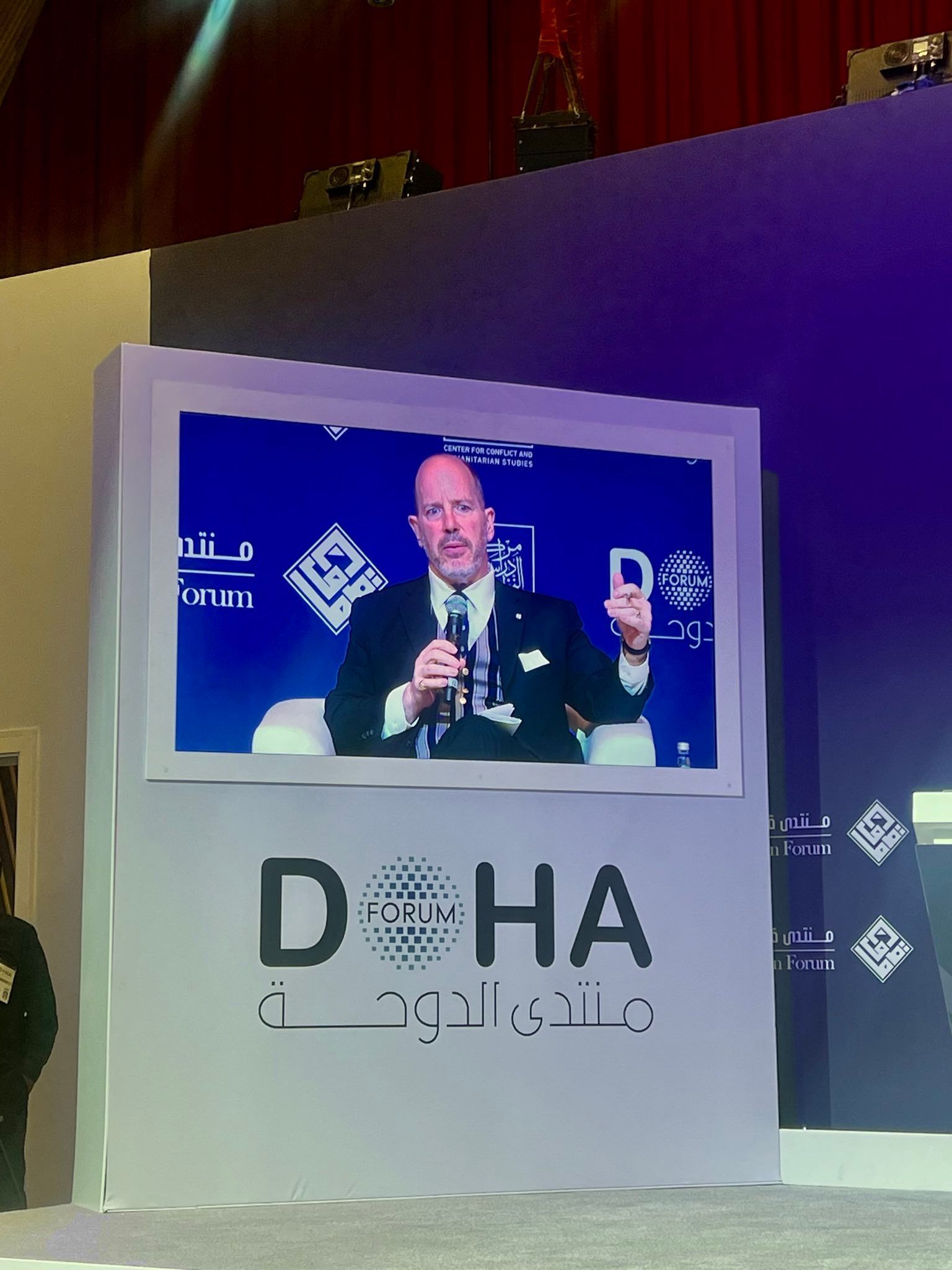
Below is the text of the prepared text upon which Dr. Ford based his remarks to a reunion at DACOR Bacon House, in Washington, D.C., of former U.S. Government officials involved with negotiating and implementing the Intermediate-Range Nuclear Forces Treaty of 1987.
It sometimes seems as if the question of arms control limitations on intermediate-range nuclear delivery systems has shadowed me for most of my life.
As a middle schooler for some odd reason precociously interested in nuclear weapons policy, I followed closely the debates and political controversies that flowed from NATO’s 1979 decision to deploy the so-called “Euromissiles” – in reality, the U.S. Gryphon land-based Tomahawk cruise missile and the Pershing II ballistic missile – in response to the Soviet Union’s earlier deployment of SS-20 systems.
I was in college studying international relations when Ronald Reagan and Mikhail Gorbachev signed the Intermediate-range Nuclear Forces (INF) Treaty in 1987, abolishing that entire class of delivery system. Years later, I followed the emergent issue of Russia’s violation of that treaty when I was a U.S. Senate staffer, and thereafter ran the WMD and Counterproliferation Directorate at the U.S. National Security Council (NSC) in 2017 when we adopted the U.S. “responsive strategy” to Russia’s violation. When the United States finally pulled out of the Treaty in 2019, I was serving as U.S. Assistant Secretary of State for International Security and Nonproliferation, and I had the honor shortly thereafter of also performing the duties of the Under Secretary for Arms Control and International Security as we took U.S. policy into the post-INF environment in the aftermath of the Treaty’s demise.
Accordingly, I wasn’t “present at the creation” of the INF Treaty like some of the other speakers at this event, but these events still feel like personal history for me. And I certainly was present for the Treaty’s collapse.
So thank you for asking me to be a part of this “INF Reunion” event! I’m sorry I have to be telling the unhappy parts of the INF story, but it’s an honor to be among you.
For my own contribution today, I’d like to record and recount my experience on INF’s deathbed, as it were, before then offering some thoughts about the two very different ways I think the Treaty haunts our arms control memory today – what I think of as INF’s two “ghosts.” These are just my own personal opinions, of course, and won’t necessarily correspond to those of anyone else, but let’s give all this a go.
Present at the Demise
By the time I left the Senate Foreign Relations Committee staff and arrived at the NSC to take responsibility for U.S. policy development and coordination on arms control in January 2017, the problem of Russia’s INF violation loomed large in our minds. It had become an especially great concern for hawkish Republicans on Capitol Hill, where frustration had been growing about the Obama Administration’s lack of concrete response to Russia’s testing of a new cruise missile in violation of the Treaty.
Some Republicans, in fact, thought the problem went far beyond merely that administration’s foolish attachment to “arms control for its own sake” and weak-kneed unconcern with violations. Having learned from an interview Under Secretary of State Rose Gottemoeller did with a Denver newspaper in 2016 that Russia had actually first illegally tested its new ground-launched cruise missile in 2008, Republican hawks on the Hill suspected that the Obama Administration had deliberately hidden news of this problem from them, stalling its revelation until after the Senate had been persuaded in 2010 to ratify the New START agreement that Gottemoeller had negotiated with the Russians over some conservatives’ objections.
To be sure, the Obama Administration apparently did only begin talking with Russia about its violation in May 2013, and it took until 2014 for them to issue a public noncompliance finding in our annual State Department report on such issues. Despite the early date of Russia’s first illegal moves, Obama officials claimed they had not reached the internal conclusion that Russia was cheating until after New START’s hard-fought ratification in 2010, but some hawkish Republicans found this explanation both implausible and rather too convenient. For some such Republicans, New START itself had thus started to seem like something of a fraud perpetrated on the Senate, and to Russia’s advantage. (That was, of course, way back when Republicans felt Russia was a national security threat, and when they thought it was the Democrats who were soft on America’s adversaries. Do you remember those days?)
Feelings also ran high because the Obama Administration had refused to do anything more than wag its finger at the Russians for the violation. As I have noted elsewhere, by the time the First Trump Administration took office, the illegal Russian missile had gone from mere developmental flight testing to the actual commencement of deployment. The threat was thus now not hypothetical, but rather dangerously concrete: a new nuclear-armed system in the field capable of ranging U.S. forces and NATO allies in Europe, and to which we possessed no countervailing capability because we had scrupulously complied with the Treaty all along.
Suffice it to say, therefore, that we were pretty darn focused on INF when I showed up at the NSC. Accordingly, it didn’t take us long in the first months of the First Trump Administration to move beyond mere finger-wagging into what we termed our “responsive strategy” of 2017. The core of this strategy was to finally provide Russia with concrete incentives to change course, and we tried to do this by authorizing the Department of Defense (DoD) to begin research and development (R&D) work on American INF-class systems – albeit ones, in contrast to the illegal Russian missile, that would be armed with conventional rather than nuclear warheads.
(Doing such R&D was perfectly legal under the treaty, by the way, as long as we stopped short of actual flight testing or manufacture. The White House’s directions to DoD were thus clear: the Pentagon was to start developing INF-class missiles up to a point just short of treaty non-compliance but go no further; anything beyond that would require a separate and specific Presidential authorization.)
Our message with this new strategy was quite clear: the Obama years in which Russia could freely work on prohibited systems while the United States remained constrained by INF Treaty limits were over. Moscow now had to choose between returning to compliance, and having America start competing with them in this space. (We also got nice support from Capitol Hill on this, with lawmakers introducing language for the 2018 National Defense Authorization bill that would authorize $58 million for initial work on a ground-launched mobile cruise missile of our own.) To make sure Moscow got the message, I met on November 6, 2017, with Russian Ambassador to the United States Anatoly Antonov to walk him through our new approach.
Three weeks later, in light of continuing Russian lies that our accusations were fantasies and they weren’t working on any new missile at all, I also publicly released Moscow’s own designator for the illegal system, revealing in a November 29 speech at the Woodrow Wilson International Center for Scholars that the Russians themselves called it the 9M729. (My revelation led Russian Deputy Foreign Minister Sergei Ryabkov to change his tune, admitting that they were actually building a new missile with that designator, but he still falsely claimed its range was too short to violate the INF Treaty.) Shortly before Christmas that year, we also put the system’s manufacturers – two Russian design bureaus known respectively as Novator and Titan – on the U.S. Commerce Department’s “Entity List” for U.S. export control restrictions.
In early 2018, with the rollout of the new U.S. Nuclear Posture Review (NPR), the United States raised the ante still further. In response to the growing problem of adversary overmatch in regional nuclear delivery systems caused by Russia’s INF Treaty violations and its failure to fulfil the promises it had made to get rid of shorter-range systems in the Presidential Nuclear Initiatives (PNIs) of 1991-92, we announced that the United States would be deploying a new, lower-yield nuclear warhead – the W76-2 – aboard some of our submarine-launched ballistic missiles (SLBMs).
The W76-2 was not an optimal solution for the problem of theater overmatch, of course, since it still rode on the Trident D5 strategic delivery system. Nevertheless, it was cheap, INF Treaty-compliant, very quickly deployable, and represented a sort of “bridge” capability to give the United States the option of at least some lower-level nuclear response in the event Russia or China used nuclear weapons in theater, thus “help[ing] counter any mistaken perception of an exploitable ‘gap’ in U.S. regional deterrence capabilities.”
The 2018 NPR also announced that we would be developing a new submarine-launched nuclear cruise missile – the “SLCM-N” – that would provide theater-range nuclear delivery capability from the sea. This was explicitly framed, in part, as a response to Russia’s INF Treaty violation. We also raised the possibility that we might perhaps reconsider this program if Russia returned to compliance. As the NPR put it,
“SLCM[-N] will provide a needed non-strategic regional presence, an assured response capability, and an INF-Treaty compliant response to Russia’s continuing Treaty violation. If Russia returns to compliance with its arms control obligations, reduces its non-strategic nuclear arsenal, and corrects its other destabilizing behaviors, the United States may reconsider the pursuit of a SLCM.
“Indeed, U.S. pursuit of a SLCM may provide the necessary incentive for Russia to negotiate seriously a reduction of its non-strategic nuclear weapons, just as the prior Western deployment of intermediate-range nuclear forces in Europe led to the 1987 INF Treaty. As then Secretary of State George P. Shultz stated, ‘If the West did not deploy Pershing II and cruise missiles, there would be no incentive for the Soviets to negotiate seriously for nuclear weapons reductions.’”
The Russians, of course, never gave us the chance to really consider implementing such a deal, for they continued to build and deploy the 9M729 missile. As our efforts to induce a change of direction from the Kremlin by finally confronting Russia with real strategic choices rather than the easy option of simply continuing to take advantage of American arms control fecklessness, the United States thus gradually moved toward formally withdrawing from the INF Treaty.
Along the way, however, we spent a lot of time trying to get our allies to come along with us. Most of all, as I recounted in a 2022 paper, we worked to get the British, French, and Germans to join us in formally admitting that Russia had indeed violated the Treaty. For some time, however, they were reluctant to do so. Some of this had to do with the intelligence information involved, for while we could share some, we couldn’t share all of our data about the 9M729 with all NATO partners. The British came around first, for we could share all the relevant information with them through the “Five Eyes” intelligence partnership. The French and the Germans held out much longer, however.
But this was clearly not just a question of intelligence sharing – though the French did rather opportunistically try to leverage the INF issue by insinuating that they might agree that Russia was cheating if we were willing to admit them into “Five Eyes.” (I give them bemused credit for trying this gambit, I suppose, but we politely demurred.) Rather than just being a question of intelligence analysis, the issue was also deeply political. The French and (especially) the Germans were palpably unsettled by the prospect of having an arms control treaty collapse, and for a long while they seemed much more comfortable simply ignoring Russia’s violation than admitting that the INF Treaty had failed. On top of that, as I have written,
“These challenges for Paris and Berlin became more acute with the election of President Donald Trump, whom they distrusted on a personal basis even on top of their political desire to avoid giving a victory to the U.S. arms control hawks who viewed Russia’s development of INF-class missiles as a material breach of the Treaty.”
Eventually, with more Russian missiles continuing to be deployed – thus increasing the threats facing NATO irrespective of one’s view on the Treaty – and with it becoming clear that the United States would pull out whether or not our allies concurred in our compliance finding, our NATO partners decided to put their political qualms behind them. On December 4, 2018, NATO’s foreign ministers issued a statement declaring that Russia was indeed in violation of the Treaty and calling upon Moscow to change course or else see the agreement collapse. “It is now up to Russia,” they declared, “to preserve the INF Treaty.”
Thereafter, it being quite clear that Russia was not going to change course, the White House issued a statement on February 1, 2019, announcing that as a result of Russia’s breach, the United States was suspending its own obligations under the INF Treaty and would begin formal withdrawal procedures. This withdrawal was duly completed in September 2019, and the INF Treaty was thus officially dead.
Today, with INF now long behind us, the issue of theater-range nuclear delivery systems has become a critical one in U.S. nuclear force posture planning vis-à-vis both Russia in Europe and China in the Indo-Pacific. As can be seen by the reports of the Strategic Posture Review Commission in December 2023 and the U.S. Institute of Peace Senior Study Group on Strategic Stability in February 2025, the American strategic policy community has now coalesced behind a new bipartisan consensus not only that we need more nuclear weapons beyond the current U.S. strategic modernization program that dates from 2010, but also that the U.S. force posture must include new theater capabilities to offset Russian and Chinese overmatch in INF-class systems.
And indeed the United States is now developing multiple INF-range systems – though again, however, so far only with conventional warheads, with the exception of SLCM-N. In late 2024, in fact, it was announced that the United States would begin deploying conventionally-armed ground-launched intermediate-range systems to Germany on a rotational basis: Tomahawk land-attack cruise missiles, a land-attack version of the Standard Missile-6 (SM-6), and a hypersonic missile would be sent on what were described as “episodic deployments … as part of planning for enduring stationing of these capabilities in the future.”
The INF Treaty era is thus now emphatically behind us. Twelve years after Russia first began to violate the INF Treaty, the United States has now begun confronting the Kremlin with concrete consequences.
The INF’s Two “Ghosts”
So that’s the story of my time at the INF Treaty’s deathbed. From the perspective of how this episode has shaped the collective consciousness of the U.S. arms control and strategic policy community, however, it seems to me that the deceased Treaty still haunts us in two ways, each of which tends to point in a different direction in terms of its potential policy implications. These are what I refer to as the “two ghosts of the INF Treaty,” and I think it’s especially important to draw attention to both of them as we consider INF’s legacy.
The Ghost of Failed Endeavor
The first aspect of this Janus-faced specter revolves around the collective memory of the INF Treaty as a failed endeavor. And this is, indeed, how many of my students seem to see it. In this failure narrative, INF was a treaty that the Soviets signed, but that collapsed because Russia cheated. Along the way, moreover, our own adherence to the agreement – as well as America’s fulfilment of our PNI promises even though Russia opted to retain a great many of the shorter-range nuclear systems it had likewise promised to dismantle – kept us from developing countervailing systems for many years. Our prolonged adherence to INF thus contributed to the risks we face today of a potential failure of deterrence in the face of Russian overmatch in a broad range of sub-strategic delivery systems that the Kremlin has made into a vital plank of its strategies of coercive nuclear bargaining.
More sophisticated adherents to this view may add that even when Russia remained compliant, the INF Treaty kept us from developing and deploying the sort of theater-class systems we need vis-à-vis China in the Indo-Pacific. Some Republican hawks, moreover, still harbor the suspicion that the Obama Administration hid Russian cheating from the Senate to get New START ratified, adding a gloss of seeming domestic political betrayal into narrative of INF’s failure.
To be fair, the Obama Administration emphatically denied any such “hide the ball” interpretation, and people I know personally who were involved in the intelligence analysis and interpretation of the Russian flight tests have told me very clearly that nothing of the sort occurred – and that collecting, assessing, and validating the relevant information on Russia’s violation simply took a lot of time (as such things often do). Either way, however, the Obama Administration’s complacency in the face of this violation while Russia continued to build and deploy systems against us still stands as a cautionary tale about how politically fashionable commitments to “preserving” arms control can create a dangerous strategic unseriousness in the halls of power.
All in all, therefore, the Ghost of Failed Endeavor presents a frightening visage, haunting future U.S. approaches by making arms control look futile and suggesting that its pursuit can undermine our security.
Don’t get me wrong: I’m not endorsing all those grim conclusions, mind you. I still like to remind my students, I fact, that we did actually succeed in making the feared Soviet SS-20s go away, of course, and that 20 years of Kremlin compliance isn’t nothing. (Nor, surely, can it be entirely unwelcome that the Treaty played a critical role in reducing tensions in the late 1980s and helping ease the two superpowers out of their Cold War rivalry.) And I certainly don’t believe that arms control is always – as some might have it – doomed, counterproductive, or both.
Nevertheless, the INF failure narrative is a telling one, and indeed offers us some genuine cautionary lessons. But it’s not the whole story, for there is thankfully a second ghost, too.
The Ghost of Negotiating Leverage
The second INF Treaty ghost has a happier face, however, and it also haunts American arms control culture as we look at the future. In this alternative narrative, the INF Treaty offers a salutary model of how to negotiate arms control agreements in the face of adversary nuclear threats. This spirit is the “Ghost of Negotiating Leverage.”
This more congenial ghost focuses not on the INF Treaty’s collapse that I witnessed firsthand, but rather upon how we got the Treaty in the first place. Specifically, it revolves around how the United States and its NATO partners reacted to the Soviet Union’s deployment of SS-20 missiles in Eastern Europe not by imagining that arms control diplomacy could magically secure us against such threats all by itself, but rather by first making a hard-nosed and politically painful decision to meet those SS-20 deployments by our own development and deployment of a countervailing “Euromissile” arsenal.
Only then could arms control diplomacy – in the form of Ronald Reagan’s famous 1981 “Zero Option” proposal – step in to make the problem go away. Successful negotiating occurred only once we had finally given our adversaries an unmistakable reason to negotiate seriously with us.
We didn’t build and deploy the Euromissiles in order to bargain them away, of course; we did that to meet what was for NATO an existential threat. Having successfully met that threat with these missiles’ contentious deployment, however, negotiating space opened up for as it became possible to envision a U.S.-Soviet deal that would bring both sides back to the status quo ante prior to the SS-20 deployments that had so worried us and our Allies to begin with. And that’s precisely the deal that Reagan struck with Gorbachev in 1987 – and that so many of you had a hand in bringing about.
Where the Ghost of Failed Endeavor counsels reticence and caution, this happier Ghost of Negotiating Leverage counsels that peace through strength is possible, and that resolute attention to meeting threats in concrete ways that change adversary incentives can catalyze arms control opportunities.
Where the Ghost of Failed Endeavor points us in the direction of pessimism, therefore, this happier Ghost of Negotiating Leverage counsels that peace through strength is possible, and that such resolute attention to meeting threats in concrete ways that preserve deterrence and change adversary incentives can sometimes catalyze arms control opportunities.
Moreover, such a steely-eyed approach to arms control “fails well.” That is, even if our own counter-deployments don’t result in arms control progress in a Reaganesque “zero-zero” sort of way, we’ve still taken key steps to counter the threats and preserve deterrence! So even if “Plan A” of a good arms control deal doesn’t pan out, the “Plan B” of simply ending up with a more robust deterrent is immeasurably better than sitting back and wringing our hands while adversaries build up nuclear posture advantages against us.
We were able to get to the INF Treaty’s landmark achievement in making an entire class of nuclear delivery system disappear for two decades, in other words, not because arms control diplomacy is a miraculous salve for all strategic ailments, but rather thanks to NATO’s steely-eyed determination in deploying Euromissiles that finally convinced Moscow that it needed to be serious in negotiating with us.
And indeed, as evidenced by the 2018 Nuclear Posture Review, this second ghost also still roams the halls of power in Washington. As you’ll recall, that document explicitly invoked the Euromissile precedent in voicing the hope that Russia might be convinced by our development of SLCM-N to change course in its illegal development of the 9M729, and it just as explicitly suggested the idea of a new, Reagan-style “Zero Option” trade. In this respect, the idea lives on of the INF Treaty as a salutary negotiated outcome made possible only by resolute attention to deterrence and to counterpoising threat against threat, and – as I pointed out in a paper published earlier this year by the National Institute for Public Policy – by an equally resolute inattention to demands from the arms control and disarmament community that we make critical negotiating concessions to our strategic adversaries.
Conclusion
I myself like to keep both of these INF Treaty “ghosts” in my head. They both have lessons to teach us, and I think they are most usefully remembered not separately but together. Years after its death, the Treaty’s twin shades serve as a salutary reminder of both of the very real potential and of the very real pitfalls of arms control negotiating.
It’s been a pleasure to be here with you to remember all this history among people who played such an important role in the INF Treaty’s complicated story arc. There is, I believe, a lot to learn from here.
— Christopher Ford